
Escher-Style Interlocking Geometric Tessellation Tiles
Periodic Tiling, Translational Symmetry & Mathematical Art
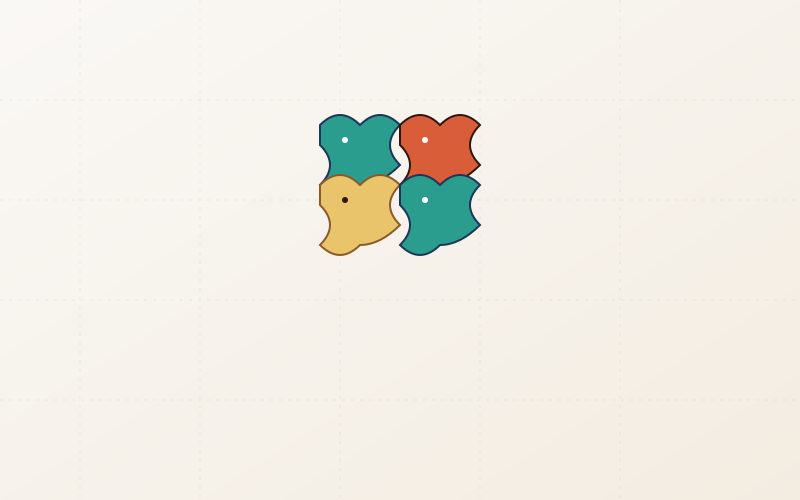
What You Need Before Starting
Assembly & Setup Instructions (5 Steps)
Follow each step in sequence. Encourage your child to participate in measuring, cutting, calibrating, and testing each mechanical and sensorial feature.
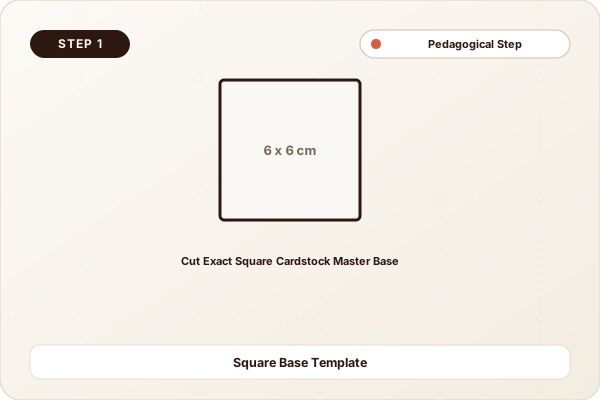
Cut the 6cm Master Template Card Square
Cut a precise 6cm x 6cm square from stiff cardstock to serve as the geometric origin tile.
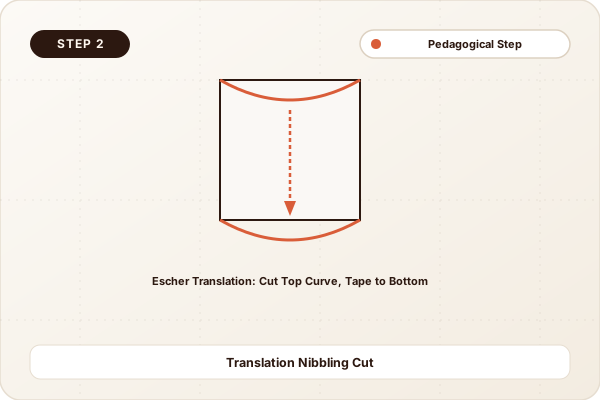
Cut a Curve on One Edge & Translate to the Opposite Side
Cut an interesting wavy curve from the top edge. Slide that cut-out piece straight down to the bottom edge and tape it securely. Do NOT rotate or flip the piece!
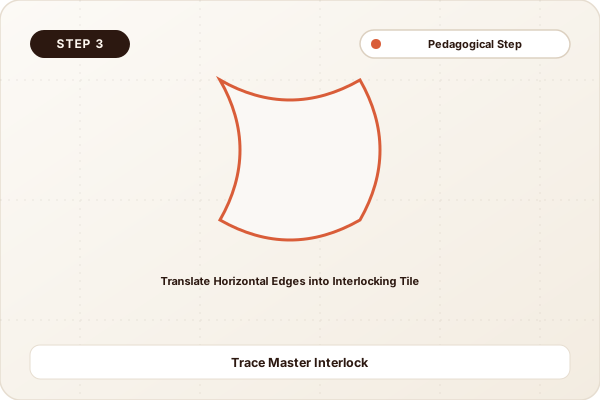
Repeat Translation for Left & Right Edges
Cut a shape (like an animal snout or wing) from the left edge. Slide it straight across and tape it to the right edge to complete the master Escher stencil.
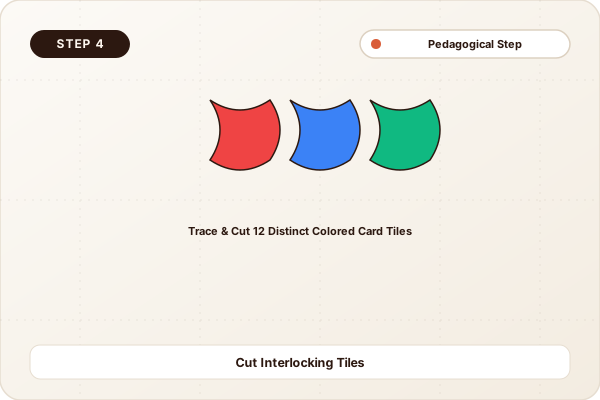
Trace & Cut 12 Multi-Colored Interlocking Tiles
Trace the master stencil onto contrasting colors of craft foam (e.g. 6 teal, 6 orange). Cut out all 12 tiles with clean, smooth contours.
Illustrate Character Details & Interlock Grid
Draw eyes, scales, or wings on each tile with a marker. Interlock the tiles together across a table to watch an endless repeating pattern emerge with zero gaps!
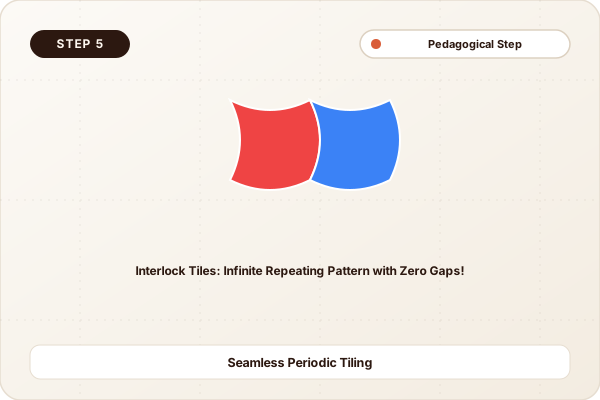
Translational Symmetry & Periodic Plane Tiling
Any alteration cut from one side of a geometric square and translated directly to the opposite side preserves the tile’s surface area and boundary interlocking symmetry, allowing infinite periodic tiling of a 2D plane.
Tessellations demonstrate how complex organic shapes (lizards, birds, fish) obey rigorous mathematical symmetry and tiling theorems.
Cognitive Milestones & Skills Developed
Spatial Symmetry & Translation
Understanding how sliding (translation) and rotating shapes preserves space-filling properties.
Mathematical Aesthetics & Art Integration
Blending geometric precision with imaginative character illustration (STEAM).
Fine-Motor Scissors Precision
Cutting matching interlocking curves and tabs that fit seamlessly together.
Fun Family Explorations & Logic Games
The Dual-Color Checkerboard Mosaic
Interlock 16 tiles alternating two colors so that no two tiles of the same color touch along their full edges.
The Rotational Hexagonal Tessellation
Start with a 6-sided hexagon base and rotate cut-out tabs by 60° to create a 3-way interlocking kaleidoscope tile.
Parent & Educator Note:
Combining the mathematical brilliance of M.C. Escher with hands-on craft, tessellations prove that math is fundamentally artistic and beautiful.
More Projects in Math & Spatial Tactile Toys & Beyond
Ancient 7-Piece Geometric Tangram Challenge Set
Craft a precision wooden or cardboard 7-piece ancient Chinese Tangram dissection puzzle with silhouette challenge cards exploring geometric transformations.
Segmented Tactile Fraction Strips & Equivalence Circles
Build a multi-color tactile fraction tile set and circular fraction pie kit from upcycled cardboard to turn abstract fractions (1/2, 1/3, 1/4, 1/6, 1/8) into concrete visual manipulatives.
Equal-Arm Arithmetic Number-Weight Equation Balance
Build an equal-arm math balance scale using a clothes hanger or wooden ruler, calibrated peg notches (1 to 10), and washer weights to balance mathematical equations visually.