
Segmented Tactile Fraction Strips & Equivalence Circles
Visual Math, Common Denominators & Hands-On Fraction Addition
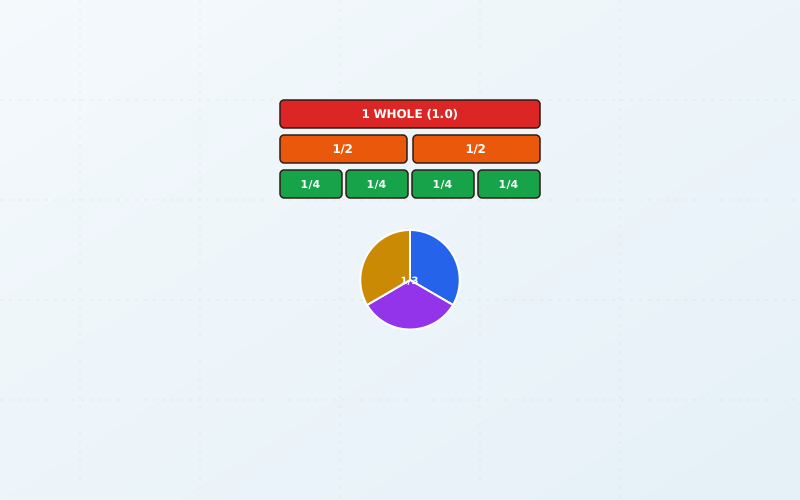
What You Need Before Starting
Assembly & Setup Instructions (5 Steps)
Follow each step in sequence. Encourage your child to participate in measuring, cutting, calibrating, and testing each mechanical and sensorial feature.
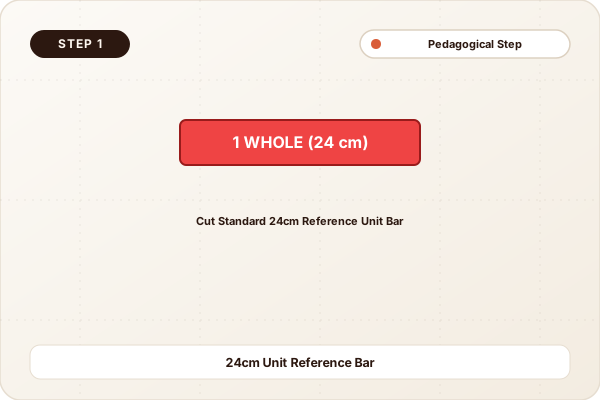
Cut the Standard 24cm Master Whole Strips
Cut 6 identical cardboard strips (24cm long, 4cm wide). The 24cm length divides evenly by 2, 3, 4, 6, and 8.
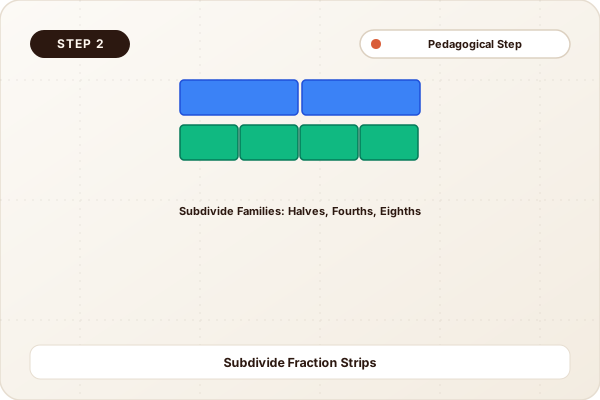
Measure, Mark & Cut Fraction Denominator Families
Leave Strip 1 intact (1 Whole). Cut Strip 2 into two 12cm pieces (1/2). Cut Strip 3 into three 8cm pieces (1/3). Cut Strip 4 into four 6cm pieces (1/4). Cut Strip 5 into six 4cm pieces (1/6). Cut Strip 6 into eight 3cm pieces (1/8).
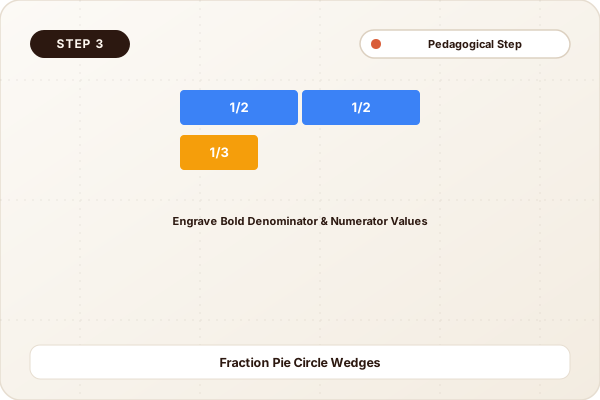
Label Fractions with Clear Bold Numerals
Write clear fractional labels (1/2, 1/3, 1/4, 1/6, 1/8) and percentage equivalents (50%, 33.3%, 25%, 16.7%, 12.5%) on both sides of each tile in bold marker.
Cut Matching Circular Fraction Pies
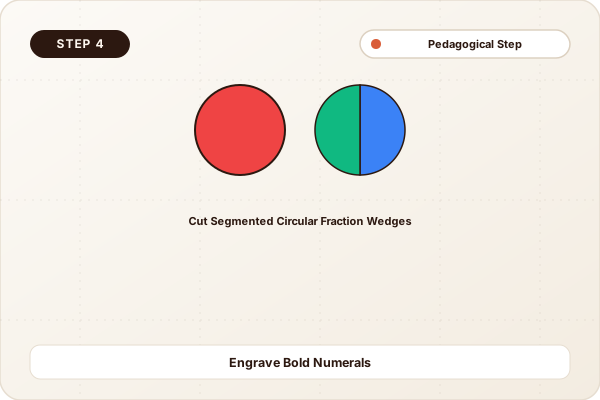
Use a compass to draw 12cm circles. Use a protractor to cut circular fraction wedges: 180° (1/2), 120° (1/3), 90° (1/4), 60° (1/6), and 45° (1/8).
Build the Dual-Lane Comparison Tray & Play
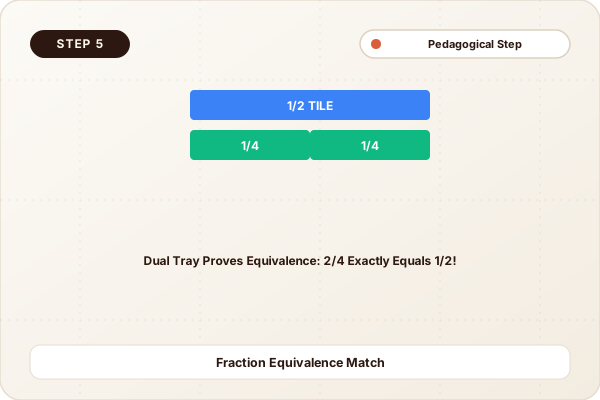
Construct a cardboard holding tray with two parallel channels. Place 1 Whole in the top channel, and challenge children to fill the bottom channel with equivalent fraction combos!
Proportional Equivalence & Concrete Operational Math
Children struggle with abstract fractions because a larger denominator (e.g. 8 vs 2) represents smaller physical pieces. Physically placing two 1/4 tiles alongside a 1/2 tile creates immediate visual and tactile proof of mathematical equivalence.
Tactile manipulatives bridge Jean Piaget’s concrete operational stage, transforming fractions from confusing symbols into tangible geometric parts of a whole.
Cognitive Milestones & Skills Developed
Fraction Equivalence Intuition
Visually discovering that 2/4 = 1/2 and 4/8 = 2/4 = 1/2 without memorizing abstract formulas.
Fraction Addition & Common Denominators
Physically combining 1/2 and 1/4 tiles in a tray to see that they equal 3/4.
Degree Angle Measurement
Using a protractor to cut 1/3 circular wedges at 120° and 1/6 wedges at 60°.
Fun Family Explorations & Logic Games
The "Make One Whole" Equivalence Game
Roll dice to collect fraction tiles and be the first player to assemble a complete 1-Whole strip without exceeding the length.
The Fraction War Card Battle
Two players each flip a fraction tile; compare them in the holding tray to see whose piece is larger—the bigger fraction takes both tiles!
Parent & Educator Note:
Fractions are often the #1 pain point in primary math. Transforming them into colorful tactile tiles eliminates math anxiety and makes fractions intuitive.
More Projects in Math & Spatial Tactile Toys & Beyond
Ancient 7-Piece Geometric Tangram Challenge Set
Craft a precision wooden or cardboard 7-piece ancient Chinese Tangram dissection puzzle with silhouette challenge cards exploring geometric transformations.
Equal-Arm Arithmetic Number-Weight Equation Balance
Build an equal-arm math balance scale using a clothes hanger or wooden ruler, calibrated peg notches (1 to 10), and washer weights to balance mathematical equations visually.
Escher-Style Interlocking Geometric Tessellation Tiles
Design and assemble interlocking M.C. Escher-style geometric tiling pattern blocks from craft foam or cardboard that fit together endlessly with zero gaps or overlaps.