
Self-Correcting Number & Shape Pegboard Grid
Autodidactic Learning, Spatial Geometry & One-to-One Number Correspondence
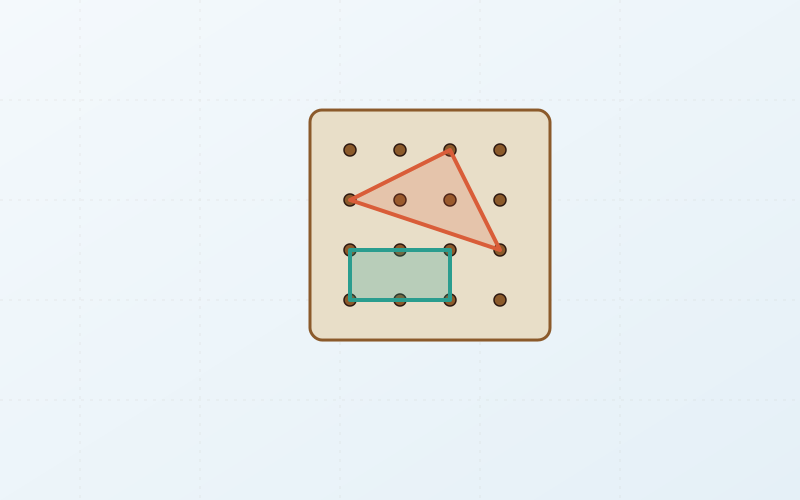
What You Need Before Starting
Assembly & Setup Instructions (5 Steps)
Follow each step in sequence. Encourage your child to participate in measuring, cutting, calibrating, and testing each mechanical and sensorial feature.
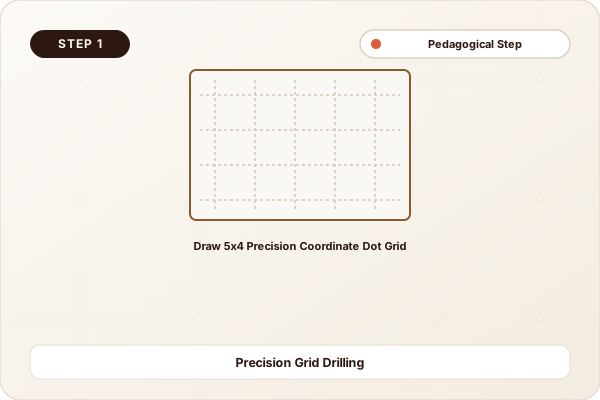
Draw the Precision Coordinate Grid
Use a ruler to draw a neat 4x4 or 5x5 grid with 4cm spacing between intersection points on the upper cardboard sheet.
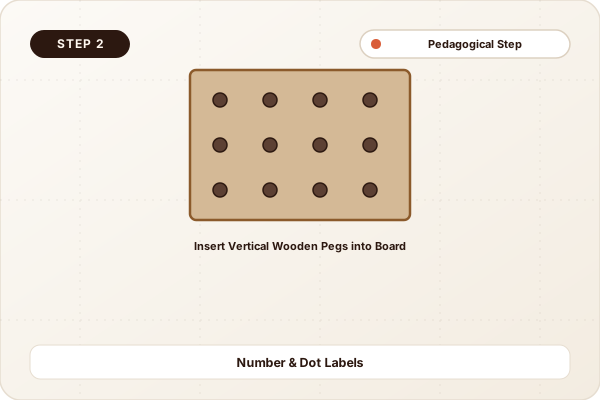
Pierce & Mount the Wooden Peg Grid
Pierce holes at all grid intersections with a pushpin. Push wooden dowels or golf tees into each hole so they protrude 2cm vertically. Secure with glue underneath.
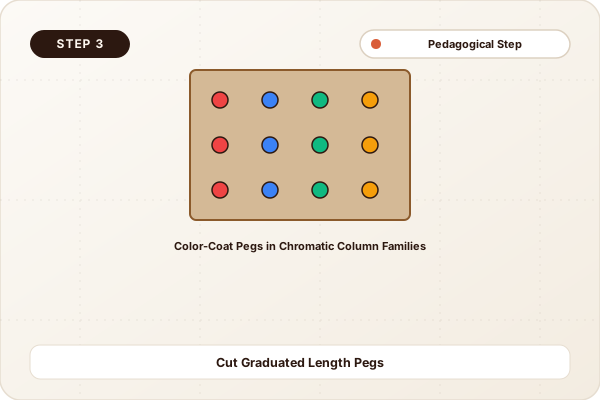
Implement the Color-Coded Self-Correcting Key
Paint the base collars of matching peg pairs with color-coded dots (e.g. matching red to red for 3+2=5). A child can look beneath the band to confirm correctness.
Create Reversible Geometry Challenge Cards
Draw mini geometry prompt cards (square, isosceles triangle, hexagon, house silhouette) with solution diagrams on the back for self-guided geoboard replication.
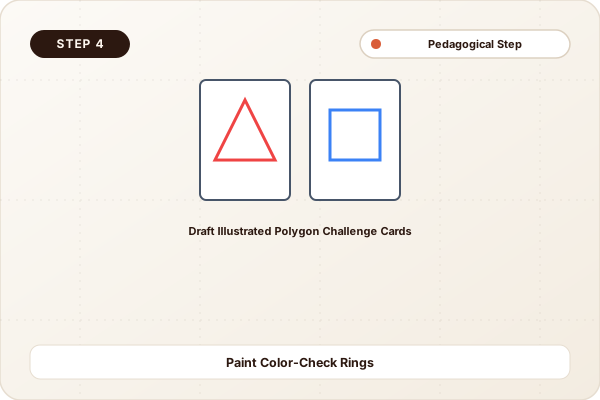
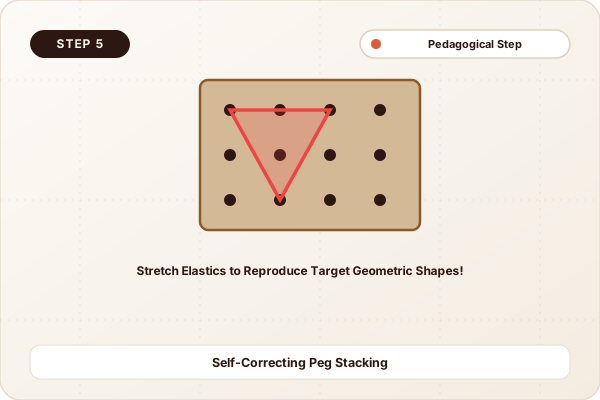
Stretch Rubber Bands & Solve Geometric Puzzles
Pick a challenge card, stretch colored elastic bands over the pegs to construct the shape, and flip the card to verify angle accuracy independently.
Montessori Control of Error & Spatial Coordinates
In Montessori pedagogy, a "Control of Error" is built into the physical apparatus so the child instantly perceives mistakes without adult correction, reinforcing internal intrinsic motivation and logical deduction.
Self-correcting design transforms mistakes into immediate visual feedback loops for independent learning.
Cognitive Milestones & Skills Developed
One-to-One Number Correspondence
Counting physical pegs and matching them to corresponding numeral slots.
Spatial Geoboard Geometry
Stretching elastic bands across coordinate pegs to construct polygons, triangles, and angles.
Independent Error Verification
Self-checking matching patterns using hidden color codes or physical keyways.
Fun Family Explorations & Logic Games
The Polygon Perimeter Detective
Construct a shape that uses exactly 12 peg boundary units and calculate its enclosed area.
Symmetrical Mirror Duel
Place a center divider band and create a complex shape on the left side, then challenge a sibling to replicate its exact mirror reflection on the right.
Parent & Educator Note:
Self-correcting toys foster resilience and deep focus because the child never feels "tested"—the toy itself gently teaches through physical interaction.
More Projects in Montessori & Sensorial & Beyond
Montessori Tactile Texture Sorting Board & Touch Discs
Construct a multi-texture Montessori sensory matching board using corrugated cardboard, burlap, sandpaper, felt, silk, and wood for blindfolded touch matching.
Nature & Geometry Loose-Parts Tinkering Tray
Assemble a partitioned loose-parts sensory tinkering tray filled with pinecones, river stones, geometric wood slices, metal washers, and yarn for open-ended creative construction.
Sensory Stepping Stones & Low-Profile Balance Beam
Build modular interlocking sensory stepping stones and low-profile balance beams using recycled cardboard, textured tops, and non-slip cork feet for gross-motor agility.