
Nature & Geometry Loose-Parts Tinkering Tray
Open-Ended Heuristic Play, Organic Symmetry & Divergent Problem Solving
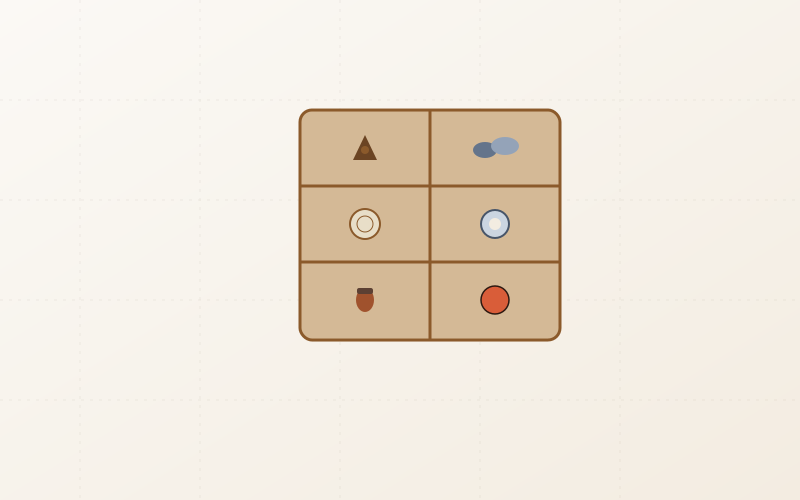
What You Need Before Starting
Assembly & Setup Instructions (5 Steps)
Follow each step in sequence. Encourage your child to participate in measuring, cutting, calibrating, and testing each mechanical and sensorial feature.
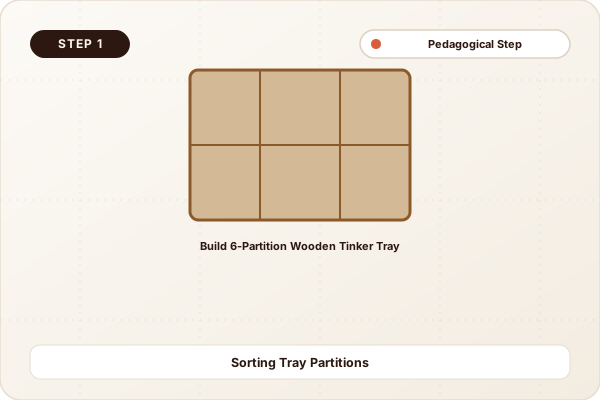
Construct the Compartment Dividers
Partition a shallow cardboard box or tray into 6 to 8 equal compartments using interlocking cardboard slotted dividers.
Curate High-Contrast Texture Categories
Collect and sort materials by tactile group: smooth river pebbles, rough pinecones, light wooden discs, cool metal washers, warm corks, and soft yarn coils.
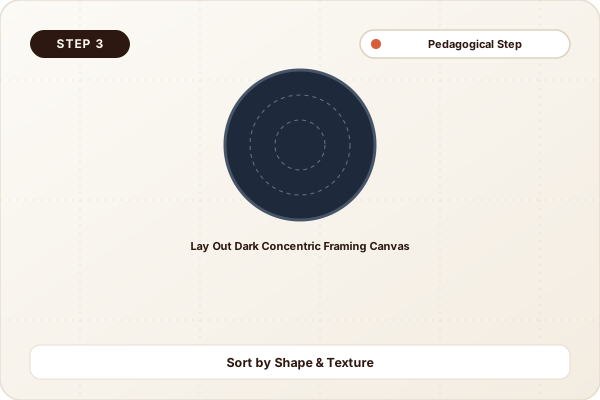
Prepare the Centerpiece Reflective Canvas
Place a flexible acrylic safety mirror or black felt canvas in the center of the play area as the design workspace to highlight radial symmetry.
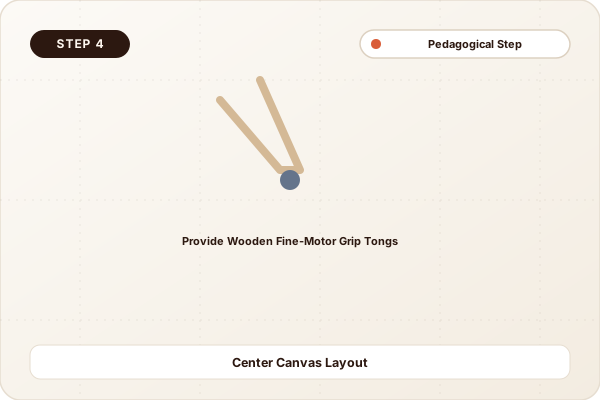
Add Fine-Motor Manipulation Tongs
Include child-sized bamboo tongs, wooden spoons, and tweezers in the kit for transferring and placing delicate items without disturbing neighboring pieces.
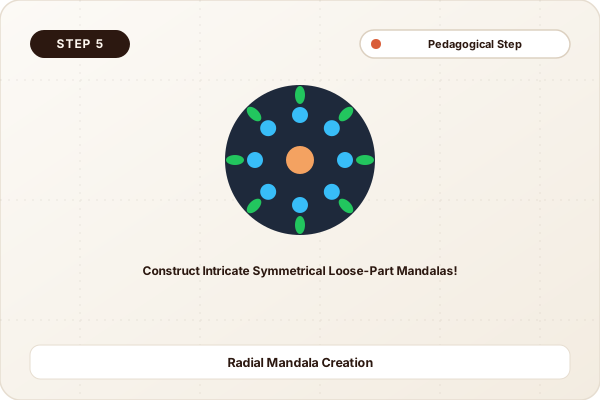
Facilitate Open-Ended Play & Pattern Mandalas
Present the tray to your child without prescriptive instructions. Invite them to build mandala patterns, animal portraits, or architectural towers freely.
Architectural Tessellation & Heuristic Learning
Loose parts possess high "affordance"—they have no fixed outcome or single correct rule. Children discover gravity, balance, natural Fibonacci spirals, and structural friction organically through unscripted play.
Open-ended materials foster 10x more divergent problem-solving pathways than single-purpose closed plastic toys.
Cognitive Milestones & Skills Developed
Divergent Spatial Creativity
Transforming abstract loose items into mandalas, animals, landscapes, or structural bridges.
Pincer Grasp & Tool Manipulation
Using wooden tongs and tweezers to sort tiny seeds, pebbles, and beads into partitions.
Mathematical Patterning & Symmetry
Creating radial rotational mandalas and ABAB repeating color/texture sequences.
Fun Family Explorations & Logic Games
The Radial Symmetry Mandala Challenge
Build a circular design starting from a central pinecone that expands outwards in 4-fold or 8-fold rotational symmetry.
The Gravity Stacking Tower Challenge
Stack an alternating tower using 3 pebbles, 3 corks, and 3 wooden slices without letting it tip over.
Parent & Educator Note:
Loose-parts play, popularized by architect Simon Nicholson, unlocks boundless imagination. There are no right or wrong answers—only pure creative discovery.
More Projects in Montessori & Sensorial & Beyond
Montessori Tactile Texture Sorting Board & Touch Discs
Construct a multi-texture Montessori sensory matching board using corrugated cardboard, burlap, sandpaper, felt, silk, and wood for blindfolded touch matching.
Self-Correcting Number & Shape Pegboard Grid
Build a Montessori-inspired self-correcting pegboard using cardboard layers, wooden dowels, and colored elastic bands that allows children to verify answers independently.
Sensory Stepping Stones & Low-Profile Balance Beam
Build modular interlocking sensory stepping stones and low-profile balance beams using recycled cardboard, textured tops, and non-slip cork feet for gross-motor agility.