
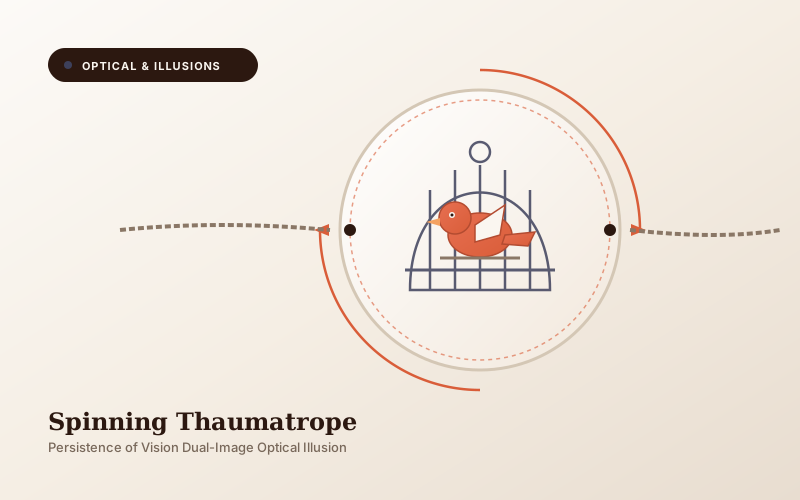
How to Create a Spinning Optical Thaumatrope
Persistence of Vision Victorian Animation Disk (Bird in Cage)
What You Need Before Starting
Folding Instructions (5 Steps)
Follow each step in order. Press your folds firmly against the table using your thumbnail or a ruler for maximum performance.
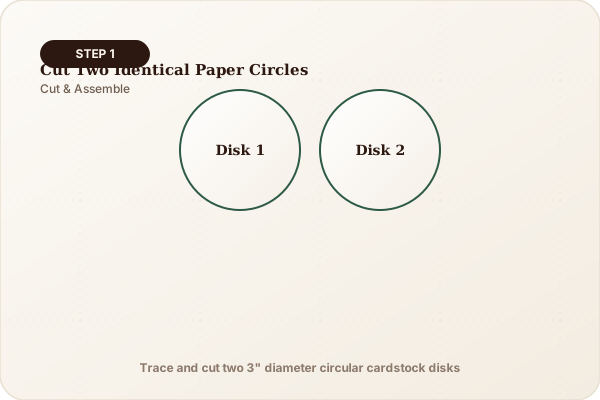
Trace and Cut Circular Cardstock Disk
Trace a 3.5-inch circle onto heavy cardstock or cardboard (a drinking glass makes an ideal stencil) and cut it out neatly.
Draw Side A (e.g. Empty Birdcage)
On the front side of the disk, draw a detailed birdcage with vertical bars, a domed top, and a center perch bar.
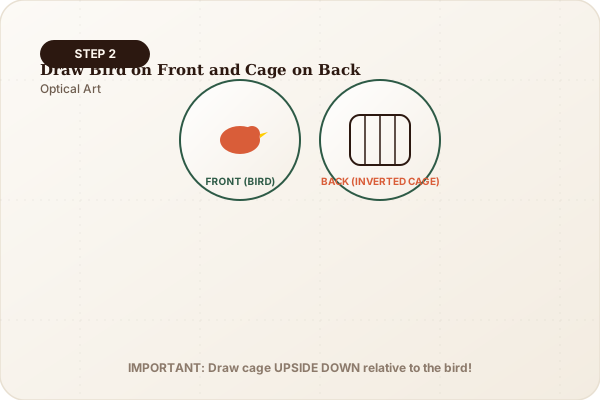
Draw Side B (e.g. Songbird)
Flip the disk over horizontally (like turning a page in a book) and draw a colorful bird in the exact same center position on the reverse side.
Punch Side Holes
Use a hole punch to make two small holes on opposite edges (at the 9 o’clock and 3 o’clock positions).
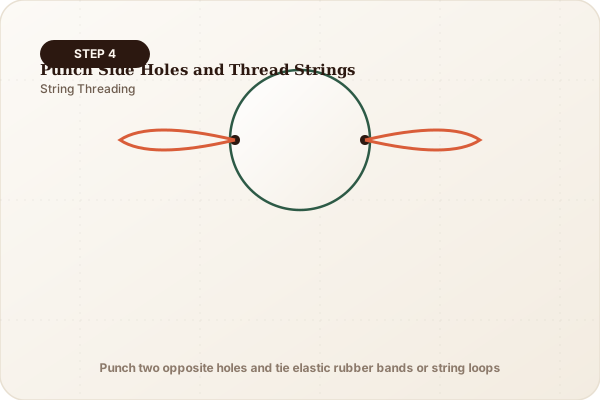
Thread Strings and Twirl to Animate!
Loop a rubber band or length of twine through each hole. Hold the strings, wind up the disk by rolling it between your fingers, pull the strings taut, and watch the bird appear inside the cage!
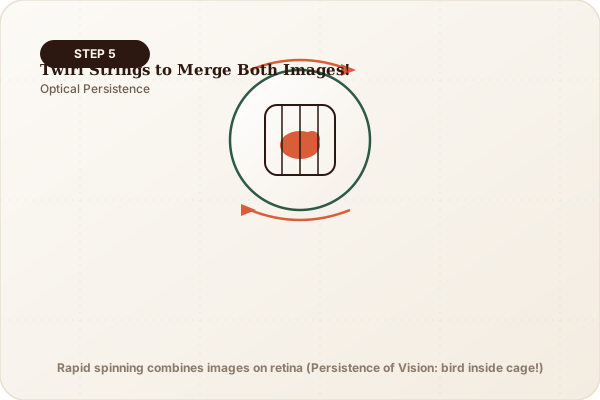
Persistence of Vision & The Phi Phenomenon
The human eye retains a visual image on the retina for roughly 1/16th of a second after the image disappears. When the disk spins faster than 20 rotations per second, your brain cannot separate the two distinct images and seamlessly blends them into one combined composite picture.
The Thaumatrope (invented in 1825) is the direct historical scientific ancestor of modern cinema, TV screens, and digital animation.
Skills Your Child Develops with This Craft
Foundational Animation Science Understanding
Learning how individual frames combine to create moving cartoons and movies.
Bilateral Wrist Twirling Rhythm
Coordinating alternating finger-twirling rhythms to keep the disk spinning continuously.
Spatial Inversion Awareness
Understanding why the reverse image MUST be drawn upside down when using vertical twirling string.
Fun Family Mini-Games to Play
Classic Animation Match Pairs
Create 3 different themed thaumatropes: Fish in Bowl, Astronaut on Moon, and Butterfly on Flower.
Straw Spinner Variation
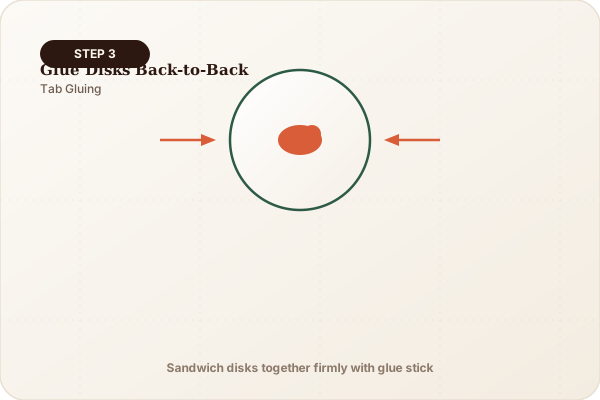
Glue the two circular drawings back-to-back with a drinking straw sandwiched in the middle. Rub the straw between your palms to spin!
Parent Note:
Children love discovering that their own brain and eyes create the magic illusion. It is the perfect introduction to animation and optical neuroscience.
More Projects in Optical & Illusions & Beyond
How to Create a Tri-Hexaflexagon
Fold a mind-bending mathematical paper hexagon that flexes and pinches open from its center to reveal hidden geometric faces and kaleidoscopic patterns.
How to Create a 3D Hollow-Face Dragon Sculpture
Build the famous Gardner hollow-face origami dragon whose head appears to physically turn and watch you as you walk past the room.
How to Create a 3D Anamorphic Desk Cutout
Draw and cut a distorted 2D geometric anamorphic artwork that appears to pop completely upright into a towering 3D block when viewed from a specific desk angle.