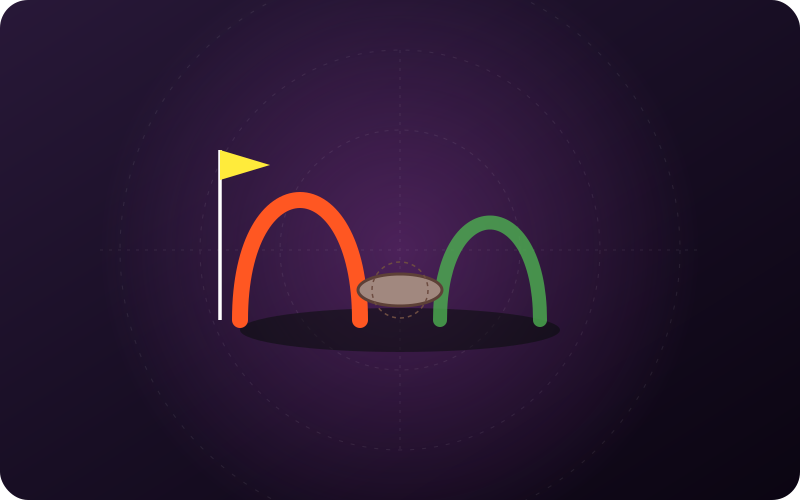
Creative Hopscotch Variations: Spiral, Snail & Math Grids
Reinvent traditional hopscotch with ancient Roman spiral snail grids, arithmetic challenge squares, and animal hops.

Dynamic Equilibrium & Foot Arch Biomechanics
Scientific Insight
Single-leg hopping requires rapid neuromuscular feedback between ankle proprioceptors and cerebellar balance circuits to maintain vertical alignment against gravity.
Ecological Value
A game requiring zero batteries or manufactured equipment, played across cultures worldwide for thousands of years.
Developmental Skills & Physical Milestones
Unilateral Ankle Stability & Balance
Landing securely on one foot without stumbling or wobbling into chalk perimeter lines.
Bilateral Coordination Switching
Transitioning smoothly from single-leg hops to wide two-footed split-stance landings.
Turn-Taking & Spatial Rule Adherence
Following strict game rules and celebrating friends’ successful turns.
Gather materials from nature, your recycling bin, or household kitchen supplies before heading outdoors.
- Sidewalk chalk in multiple bright colors
- Flat throwing marker stones, bean bags or rubber pucks
- Measuring tape or chalk string line (optional)
Step-by-Step Play Blueprint
Follow these 5 guided steps. Let your child take the lead in modifying and experimenting with the rules as play unfolds.
Draw the Spiral Snail ("Marelle / Escargot") Grid
Instead of linear boxes, draw a giant chalk spiral curled like a snail shell with 10 to 15 numbered compartments leading to a central circular "Rest Haven".
Select Smooth, Non-Bouncing Throwing Stones
Find flat river pebbles that slide smoothly onto target squares without tumbling off-grid. Let children personalize their stone with paint or chalk.
Master the Standard Toss and Single-Leg Hop
Toss stone into Square 1. Hop through the course on one foot, skipping Square 1. Land with two feet on paired squares (4-5 and 7-8), turn 180 degrees, and hop back, retrieving the stone on one foot!
Claim "Home Base" Resting Territories
In Escargot, when a player successfully traverses the snail into the center and back, they claim one square where they can rest on two feet, while other players must hop over it!
Introduce Math and Spelling Variation Grids
Write letters or multiplication numbers in each square. Players must shout words starting with the letter or solve the math equation before hopping forward.
Ensure children wear supportive sneakers with good rubber grip to prevent ankle twists on rough pavement.
Fostering Autonomy & Calculated Risk
Hopscotch builds foundational athletic agility and vestibular balance. Its global history (from ancient Rome to modern schoolyards) shows the universal joy of hopping.